
40 LinkedIn Post Ideas for B2B Leaders (Sorted by What Actually Books Calls)
40 LinkedIn post ideas for B2B founders and execs, sorted by the content mix that books sales calls. Each one comes with a hook you can steal today.



You opened LinkedIn to post something. You stared at the box. You closed LinkedIn.
I see this every week. Smart founders, sharp sales leaders, CEOs who can talk for an hour about their market without notes. Then the "Start a post" box shows up and their brain goes blank.
So I made you a list. Forty LinkedIn post ideas, and most come with a hook you can lift word for word. They're grouped the way your feed should be weighted if you sell B2B and want those posts to turn into sales conversations. Not likes. Conversations.
I write LinkedIn content for executives and company pages every day. One client's company page did 1,472,513 impressions last year. A CEO I ghostwrite for saw his impressions jump 215% in his first 90 days. None of it came from a viral formula. It came from the list below, used over and over.
Before the list: why you run out of things to post
You don't run out of ideas. You run out of noticing.
Every week you have a customer call where someone says something surprising. A deal stalls for a reason nobody predicted. Someone on your team does something smart. That's a post. Probably three.
None of it gets written down. Then Thursday at 8 a.m. you're back at the blank box, inventing. Fix it right now: open the Notes app and make a note called "Posts." Every time something makes you think huh, drop one line in it. That habit alone will cover half of this list.
(If you have a marketing person, give them 30 minutes with you every Monday instead. I call it the Monday 30, and it's the backbone of the content system I run for small teams.)
The content mix that turns posts into pipeline
Here's how I weight a B2B feed:
- About 50% educational. How-tos. Checklists. The stuff people save.
- About 20% social proof. Client wins and results, used to teach.
- About 15% opinion. Take a side.
- About 15% personal. People buy from people.
The 40 ideas follow that same split. Twenty educational. Eight proof. Six opinion. Six personal.
Lean too hard on product and people quietly scroll past you. Lean too hard on personal and you're a lifestyle account. The mix is what keeps a VP reading your stuff for six months before they reply to a DM.

Educational LinkedIn post ideas (20)
Half your feed lives here. When a buyer finally gets budget in Q3, they remember who taught them something back in Q1.
1. The step-by-step. Pick a process you could do half asleep and write it out. "Our 5-day client onboarding, every step:"
2. The mistake you see constantly. "I've reviewed [number] sales decks this year. Most of them make the same mistake on slide 2."
3. The before-and-after. Show something you fixed. A headline. An email. A pricing page. Screenshot both versions.
4. The number that surprised you. "We sent 122 DMs in 3 weeks. 12 turned into booked calls. Here's what the 12 had in common."
5. The question a customer asked this week. Answer it publicly. If one customer asked, fifty are wondering.
6. The myth. "Nobody needs 10,000 followers to get leads here. [Client type] did it with under 1,000."
7. The tool stack. What you actually use, what it costs, and the one you'd cut first.
8. The glossary post. Define three terms your buyers pretend to understand. Nobody admits this stuff in a meeting.
9. The "how I'd do it from zero" post. "Pipeline at zero. No budget, no team. Here's what I'd do Monday."
10. The framework. Name your process. Sketch it on a napkin if you have to, then post the napkin. Named things get remembered.
11. The checklist. Ten yes-or-no items. People save these like crazy.
12. The teardown. Pick a public launch or a homepage you like and point out what's working. Be generous. Nobody hires the guy who dunks on people.
13. The industry change, translated. Some new rule just dropped in your industry. Your buyers haven't read it. Explain it like you're talking to one of them over lunch.
14. The comparison. Put two approaches next to each other and let the numbers argue. I ran cold email against LinkedIn DMs for the same client. Cold email booked zero calls. LinkedIn booked 22.
15. The "what I'd tell my first-year self." Five lessons, one line each.
16. The objection, answered. Pick the sales objection you hear most. Answer it like you would on a call, minus the pitch.
17. The cost breakdown. What does the thing you sell actually cost, and why? Buyers search for this. Hardly anyone publishes it.
18. The time-saver. One small trick that saves your team an hour a week.
19. The resource roundup. Three books or podcasts that changed how you work. One stolen idea from each.
20. The prediction. Where's your industry headed by next fall? What are you already doing about it?
Social proof post ideas (8)
Proof posts work when they teach. "We helped a client grow!" is noise. The how is what makes it a post.
21. The client result, with the method. "This logistics company doubled its LinkedIn following in a year. Here's the posting schedule we used." (That one's real, by the way.)
22. The screenshot. A kind email or a DM reply from a prospect. Blur the name. Let it speak.
23. The "check the photo" chart. An analytics graph with an arrow pointing at the moment something changed. One sentence explaining what changed.
24. The customer spotlight. Make your client the hero. Tag them if they're happy to be tagged.
25. The milestone. 100th client, 5 years in business, first enterprise logo. Then thank the people who got you there.
26. The long game. "This prospect ignored me for [X] months. Last week they booked a call." The silent ones are often reading everything.
27. The team win. Celebrate someone on your team by name. These quietly out-perform most company announcements.
28. The "what didn't work." A failed test, the number behind it, and what you changed. Honesty is its own kind of proof.
Opinion post ideas (6)
This is the part people skip because it feels risky. It's also the part that makes you memorable. No grey area.
29. The unpopular take. "Most B2B companies should stop posting from their company page and start posting from their CEO's." (I believe this. Executive posts get four to five times the engagement.)
30. The "everyone says X, but." Pick a piece of standard advice in your industry and push back on it with a reason.
31. The line you won't cross. A type of client, tactic, or deal you turn down, and why.
32. The hot take on a trend. AI, a new platform, a buzzword. Where you actually stand, not where it's safe to stand.
33. The bad-news forecast. Something your industry doesn't want to hear. Be kind about it. Bring receipts. Don't fold in the comments.
34. The "I changed my mind." Something you believed three years ago and don't now. This one builds more trust than almost anything on the list.
Personal post ideas (6)
You're not a logo. People who'll eventually sign a contract with you want to know who's on the other side of it.
35. Your "why." Why you started the company, in one honest story.
36. The school drop-off thought. The idea that hit you at 7:45 a.m. in the car line. (Mine show up there constantly.)
37. The hobby that teaches something. I collect sports cards. There's a post in there about scarcity and pricing.
38. The hard week. Something went wrong. What you learned. Skip the pity party.
39. The place. Your city, your office, your favorite ballpark. Texas shows up in a lot of mine.
40. The person who shaped you. A first boss, a coach, a parent. What they said that you still repeat.
How to write engaging LinkedIn posts (so the ideas actually land)
A good idea in a bad post still dies. Six things fix most of it.
Open with a number or a problem. The first two lines show before the "...see more" cut. "3 weeks, 122 DMs, 12 calls booked" pulls people in. "I wanted to share some thoughts on outreach" doesn't.
Write short lines. One idea per line. White space on mobile. Most of your readers are thumbing through on a phone between meetings.
Keep links out of the post. LinkedIn hates it when you send people somewhere else. One Forbes estimate put the reach penalty around 60%. So the link goes in the first comment. Better yet, no link at all.
Use real visuals. A screenshot. A chart. Your actual team at the actual trade show. Stock handshake photos? Your buyers have seen that exact one a hundred times.
Sound like yourself. Pangram Labs found that 41% of long-form LinkedIn posts are now AI-generated, a higher share than X, Reddit, or Medium. Scroll for 60 seconds and you'll spot it. Same rhythm, same emojis, same "Let that sink in." Good news for you, honestly. Sound like a person and you're already ahead.
Ask something easy at the end. "Thoughts?" gets crickets. "What objection do you hear most?" gets answers. And comments push the post out past your own network.
Turn one idea into five posts
You don't need 40 ideas a month. You need about eight good ones and a habit of stretching each.
One client result can become a proof post (#21), a chart post (#23), a "what didn't work" post (#28), a step-by-step (#1), and an opinion (#30). Same story. Five angles. Five weeks of content.
I call it the 1-to-5 rule. It's the main reason a team of two can post every weekday without burning out.
Posts build the audience. DMs book the calls.
Here's the part most "LinkedIn post ideas" lists leave out.
A post has never closed a deal by itself. Here's what it actually does. Your connection request lands. The prospect clicks your name and scrolls. What they find there decides whether your DM gets a reply.
The DM books the call. The posts got you the reply.
Run both. I lay out the whole loop (optimize, connect, create, message, close, repeat) in the Wheel of LinkedIn Prosperity.
Your first week
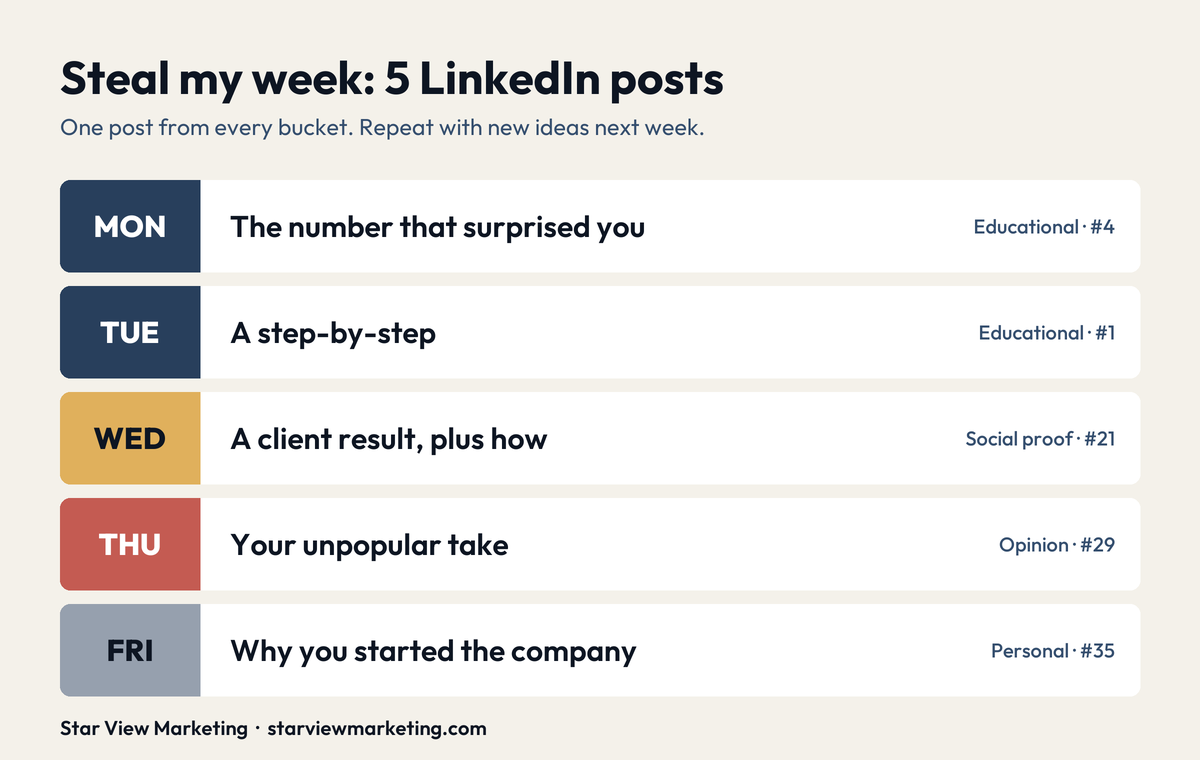
Not sure where to start? Steal my week:
1. Monday: the number that surprised you (#4)
2. Tuesday: a step-by-step (#1)
3. Wednesday: a client result, plus how you got it (#21)
4. Thursday: your unpopular take (#29)
5. Friday: why you started the company (#35)
Five posts. Every bucket covered. Then go back to the top next week and pick five more.
FAQ
What should I post on LinkedIn as a B2B founder or executive?
Write about the problems your buyers pay you to solve. Roughly half your posts should teach: how-tos, frameworks, mistakes you keep seeing. About a fifth should be proof. Split what's left between opinions and personal stories. And use real numbers whenever you have them.
How often should I post on LinkedIn?
Consistency beats volume. Three posts a week that you can keep up in December is better than five a week you abandon by February. Every weekday is a great goal, but build up to it. If you're starting cold, three days a week for 90 days is a solid test.
Do LinkedIn posts actually generate leads?
On their own, rarely. Posts build familiarity and trust. The leads come when you pair content with targeted connection requests and real one-to-one DMs. Prospects check your profile and recent posts before they reply, so good content is what makes the outreach work.
Want the full system that turns posts into booked sales calls? Get the Wheel of LinkedIn Prosperity. It's the six-stage LinkedIn program I run for clients, free.
Rather have someone write the posts for you? That's most of what I do. See how the LinkedIn program works, or book a strategy call and I'll map out your first month of content live.

