
B2B Content Marketing Strategy on a Team of Two (1.47M Impressions, One Marketing Hire)
A B2B content marketing strategy built for one marketing hire, not a department. The system behind 1.47M LinkedIn impressions at a freight tech startup.




Most B2B content marketing advice was written for a department that no longer exists.
Editorial calendar. Content pillars. Persona workshops. A brand voice document nobody reads. That machinery assumed eight or ten people in a marketing org, and in 2026 a lot of B2B companies have one marketing hire, a product worth talking about, and a CEO asking why nobody knows who they are.
I've been the other half of that team for almost three years at a freight technology startup. One marketing employee inside the building. Me outside it. One year of that: 1,472,513 LinkedIn impressions. 1,457 new followers. Five written case studies. A newsletter that picked up 503 subscribers. All of it running underneath a Series C raise.
Two people. That's the whole marketing team.
This is the strategy underneath it, and none of it requires a bigger headcount.
Why most B2B content marketing strategies collapse on small teams
The plan is rarely the problem. The plan is usually beautiful. It dies for a boring reason: the person responsible for it has no way to get information out of the people who have it.
Your engineers know why the product matters. Your sales team knows the four objections that kill deals. Your CEO knows where the market is going because three customers told him last week. None of that is written down anywhere, and the marketing hire — the one who was told to "own content" — is sitting there trying to invent thought leadership from a product sheet.
So the output goes generic. Generic gets ignored. Six months later somebody says content doesn't work for us.
Here's the reframe that changes everything for a small team:
You do not have a writing problem. You have an extraction problem.
The content already exists. It's trapped inside busy people who will never sit down and type it. A B2B content marketing strategy for a team of two is really a system for getting it out of them, on a schedule, without asking them to write a single word.
Step 1: The Monday 30
Every Monday afternoon at a regional logistics client, I got 30 minutes with the CEO and the head of sales. That's it. Half an hour.
We didn't talk about content. We talked about the business. What happened at the customer visit. Which deal fell apart and why. What the freight market was doing to their rates. Who's speaking at the conference in March. What the guy on the dock said that stuck with them.
Then I went away and wrote a month of content out of it.
I call it the Monday 30, and it is the single highest-leverage habit in small-team B2B marketing. Thirty minutes of conversation reliably produces four to six weeks of material, because you're not asking two executives to generate ideas. You're asking them to describe their week, which they can do in their sleep.
Three rules make it work:
- Put it on the calendar as a recurring hold. The instant it becomes "let's find time," it's over.
- Record it. Your best lines will be things they say offhand, in their own words, and you will not remember them.
- Never ask "what should we post about?" You'll get silence or a product announcement. Ask what happened, what's annoying them, what a customer said. The posts are hiding in the answers.
If you're a one-person marketing team reading this and thinking you can't get 30 minutes with your CEO — that's your real strategy problem, and it's worth escalating. Thirty minutes a week is less time than most executives spend approving the content those same thirty minutes could have produced.
Step 2: Decide what you want to be the loudest voice about
The freight tech category is crowded and noisy. Every competitor posts. Most of it is product news and recycled industry stats, which is exactly why there was an opening.
We picked a lane: talk like an operator, not a vendor. Show the work, the customers, the people, the actual freight. Then show up every single working day inside that lane and let the vendors take turns being forgettable.
Within a year the brand was the dominant voice in its category on LinkedIn. Not because of budget. Because everyone else was inconsistent and interchangeable.
Pick the thing you can credibly own and say it relentlessly. Narrow beats broad when you have two people, because narrow is the only thing two people can dominate.
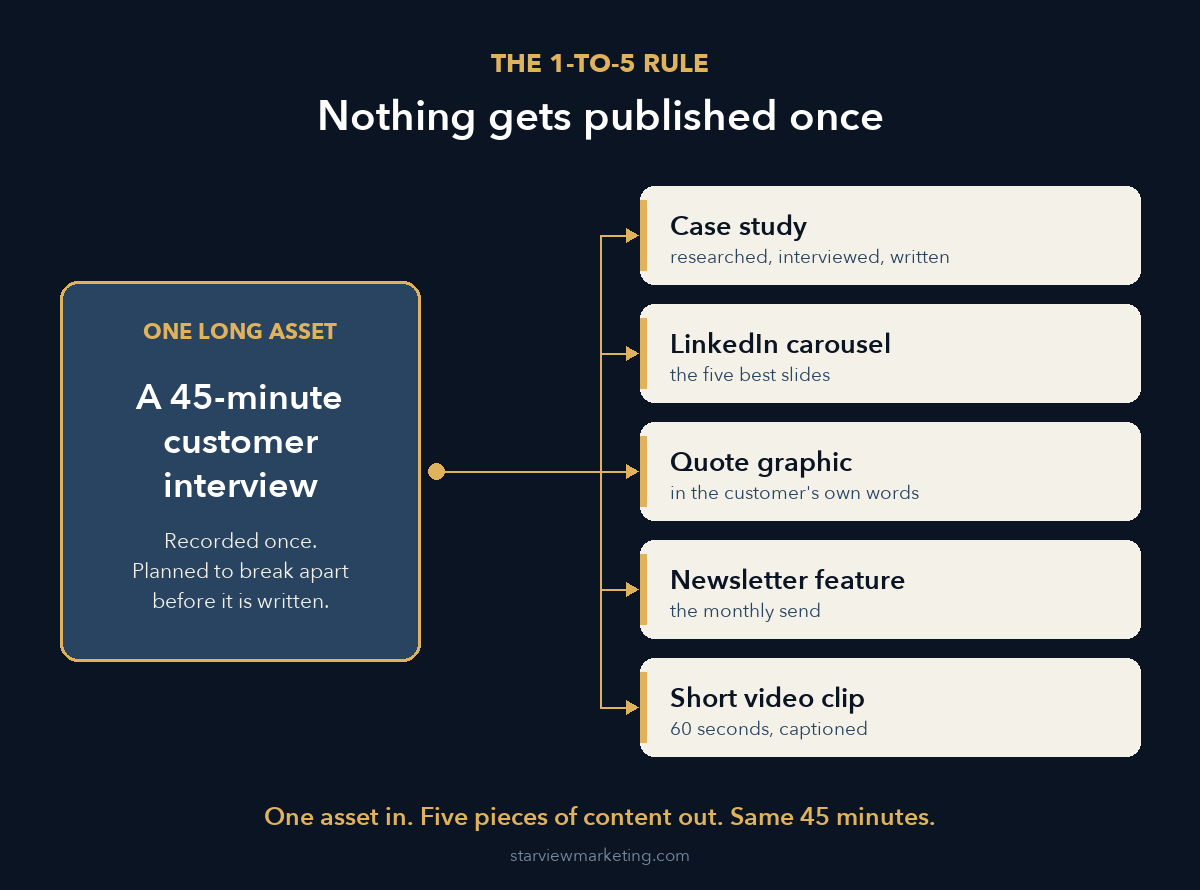
Step 3: The 1-to-5 rule — nothing gets published once
This is where small teams win back the hours.
Every long asset gets built to be broken apart. That's a production decision you make before you write it, not a repurposing chore you do after.
- A case study becomes a carousel, a customer quote graphic, a newsletter feature, a short video, and three standalone posts about the individual results.
- A webinar becomes five clips.
- A podcast appearance becomes a week of content.
- A white paper becomes a month of them.
At the freight tech company, five case studies a year is not five pieces of content. It's closer to forty. The interview behind each one — and I run those interviews myself, with real customers and internal subject matter experts — generates more usable material than the case study itself ever uses.
One long asset. Five children. Publish it once and the rest of it just sits in the file, unread, forever.
The mix I use is the content half-life. Half educational. A quarter social proof. The rest split between opinion and something personal. Tip it too far toward product and people quietly stop reading, which you will not notice until a quarter has gone by.
Step 4: Five days a week beats five perfect posts a year
The freight tech company posts Monday through Friday. Every week. Video, carousels, employee spotlights, event photos, customer testimonials, clips.
The logistics client went from posting whenever someone remembered to posting on a real cadence, and their following more than doubled in a year — under 1,000 to over 2,000, with 234,824 impressions. Per post, that page outperformed accounts I manage with close to 20,000 followers.
A smaller audience that shows up every day beats a larger one that goes quiet.
Consistency is also the only variable in this entire article that is fully inside your control. You can't control the algorithm. You can't control whether a post lands. You can absolutely control whether something goes out on Thursday.
Step 5: Move the best content to a human face
Corporate pages have a ceiling. Posts from executives get four to five times the engagement of the same post on a company page, because people follow people.
So at the logistics company, year two was the CEO's profile. I ghostwrote his posts and sent 200 targeted connection requests a week from his account to their ideal customer profile.
First 90 days: 33,596 impressions, up 215%. 862 engagements, up 245%. 9,413 members reached, 664 profile viewers, 16% follower growth.
Same company. Same market. Same writer. The only change was whose name was on it.
If you're short on time, there's a lighter version I call the 2-Step Flow: post on the company page, then have an executive reshare it with a one or two sentence note of their own. A reshare underperforms an original post, but an executive resharing beats an executive doing nothing. It costs them 45 seconds.
Step 6: Content builds the audience. It does not close the deal.
This is the part small teams get wrong most often, and it's the reason "content marketing doesn't work" gets said out loud in so many Monday meetings.
Content is a role player. It grabs rebounds, plays defense, makes the extra pass. It doesn't score.
Direct messages score.
At the freight tech company I eventually took over a senior leader's LinkedIn account and started working the target list — specifically the accounts no salesperson had been able to reach. First week of outreach: two of those accounts replied.
That only worked because two years of content had already run. The prospect who gets your DM checks your profile. Then your company page. Then your posts. Content is what makes a cold message feel warm, which is why I'd rather you run both than run either one perfectly. The full six-stage system is here.
What a team of two actually produced
The freight technology startup, in one year:
- 1,472,513 LinkedIn impressions, 6,742 reactions, 233 comments, 155 reposts
- 1,457 new followers, 38,141 page views, 15,645 unique visitors to the company page
- Five case studies, researched, interviewed, and written
- A monthly newsletter at 13,695 article views and 503 new subscribers
- Blog and white papers running every month, optimized for search
- The dominant voice in its category, on the way to a Series C
That's one marketing employee and one outside consultant. Not a department.

Your first 30 days
If you want to start this Monday, in order:
- Book the Monday 30 as a recurring calendar hold with whoever knows the most about your customers. Record it.
- Write down the one thing you want to be the loudest voice about. One sentence. Tape it to the monitor.
- Pick your one long asset for the month — a customer interview is the highest-yield choice — and plan its five children before you write it.
- Commit to a cadence you can hold in December, not one that impresses you in January. Three days a week you'll actually do beats five you'll abandon.
- Get one executive posting, even if it's only the 2-Step Flow reshare.
Do that for 90 days before you evaluate anything. Content compounds, and the ugly part of compounding is that month three looks identical to failure. Month three is where almost everybody quits.
FAQ
How often does a B2B company actually need to post?
Cadence matters more than volume. One post a day on LinkedIn, Monday through Friday, plus one substantial long-form asset a month, is enough to dominate most B2B categories — and it's achievable for two people using the 1-to-5 rule. The companies that win aren't posting more than you. They're still posting in month eleven.
Should we post from the company page or from executive profiles?
Both, and weight toward the executive. Executive posts earn roughly four to five times the engagement of company page posts. Run the company page as the credible home base for proof and product, and use a leader's profile as the voice that starts conversations. When time is short, the 2-Step Flow gets you most of the benefit for 45 seconds of executive effort.
How do you do B2B content marketing with one marketing employee?
Quit thinking of it as a writing job. It's an extraction job. Get 30 recorded minutes a week with the people who know things, build every long asset to break into five smaller ones, and hold a cadence you can sustain. That's the entire model behind 1.47 million impressions on a team of two.
Want the system that turns that audience into booked sales calls? Get the Wheel of LinkedIn Prosperity — the six-stage LinkedIn program I run for clients, free.
Or if you'd rather skip ahead: book a strategy call and I'll tell you what I'd do with your two people. I take on three new clients a month, and I'll tell you honestly if you're not one of them.
Running LinkedIn for a B2B company with a team this size? That's most of my clients. Here's how the program works.

